St. George Marathon – Race Report

marathon2

Ilana Katz MS, RD, CSSD

It’s been more than a week and the obligatory race report has been calling my inner conscience. This marathon report feels especially significant to me, as it was followed by a week of  (sometimes) strenuous hiking and exploring beautiful Utah.
marathon3

Believe it or not, Ironman Chatty, although two years ago for me, still feels like yesterday… I am not ready for another Ironman quite yet, although am having endurance withdrawals. This lead to the declaration of 2016 being the year of  “Just a Marathon.”  Oh yeah, there is even a hashtag for #justamarathon, for all the crazy ultra-endurance peeps who one day “submiss” themselves to just a marathon. For all those others rolling their eyes, don’t be haters, there is no real help for endurance junkies other than endurance.  I have gone on a tangent now, but: This always reminds me of the time I was giving a sports nutrition seminar to a group called “couch to 5k” and during the presentation I kept saying “its only a 5k”  – granted, I was genuinely referring to the science of sports nutrition that in a 5k one typically does not have to focus on in-depth sports nutrition so to speak, but from their point of view, I was belittling them. Oh goodness did I get schooled when one of the group raised their hand and blurted out “please stop saying it’s just a 5k.”   And I have learned a very important lesson since then… y’all know what that is. On that very note, I will certainly contest that from experience, running a marathon (and training for it) can be just as tough, if not tougher than training and racing an Ironman.  Any takers? (oh you ironman peeps, calm your hormones ;-))

The year of the Marathon began with my application via the lottery for NYC marathon. I was dropped like a hot cake. The usual “we regret to inform you that most first time applications in this lottery are turned down… so keep on trying.” Maybe in year 7 it will happen for me, maybe I will eventually get in to NYC (by which time I would more than likely be hobbling a marathon.)  So that turn down lead me to sign up for a different, lesser known, but probably almost as coveted St. George, and it too was a lottery… one that I actually won. Congratulations Runner, you are in it to win it!! And so the training began.

Many months and many long run days later: It was a gorgeous day in St. George. Started off cold, colder than expected.  I was under the false impression that early October is still warm in most parts of the country. I was waiting on the bus to transport all us eager beavers 26.2 miles up the road to the start, comparing my little running skirt and sports bra outfit to many of the over-dressed, sporting hat and gloves, long running tights, bundled in fleece. My inner laugh was “oh are y’all gonna be hot as hell.”   Fast forward 26.2 miles out and 2500 feet elevated from the last sentence. Now look whose laughing. Shivering to the bone, I was very grateful for the space blanket handed to us inexperienced Utah-in-the-Fall newbies. Get this, there were even pit fires one could huddle around, it was very well thought out and warming.

The course was wonderfully scenic, all you ever wanted in a marathon. There were a couple of tough challenges, namely mile 8 – 12ish was just one long climb with no breaks (the elevation map lied).  The reprieve was mile 16 to the end was one long downhill. Now that may sound like chocolate icing on top of a chocolate cake to a marathoner, but some of it was pretty steep, and steep downhills are the other side of the pendulum to steep uphills. Pendulum extremes, no matter which end, are extremely challenging. One really has to put the brakes on if you want to save your quads for as minimal as “walking” the next day (and don’t forget, I had a solid 5 days of strenuous hiking to follow).  I heard that little voice in my head, planted by a fellow endurance junkie, an experienced St. George marathoner, recommending some hill repeat training (and only now did the hill repeat DOWHILL ring a bell…. Oopsy daisy).

I had a difficult time around mile 11 or so, not feeling good, wandering why the hell I sign up for this stuff… I did all the required training, what the fiddlesticks? One starts going over and over in their head what could be different… yeah, could have run more during the weeks, yeah could have trained more on hills, yeah yeah coulda shoulda… but not to diss my training, because from after that bout of feeling miz I started feeling great, and the training pay off started paying off. I could have flown to the end but I had committed interval sets as a race strategy. Famous last words from coaches; Stick to the race plan. It also included some mmm…mmmm delish mocha gels every 30 – 45 minutes, and boy when you are really focused on getting sports nutrition right, you better find a flavour that you can stomach. Mocha y’all. Specially for those coffee addicts. Its my new favourite.  Sickly sweet salted caramel move over.

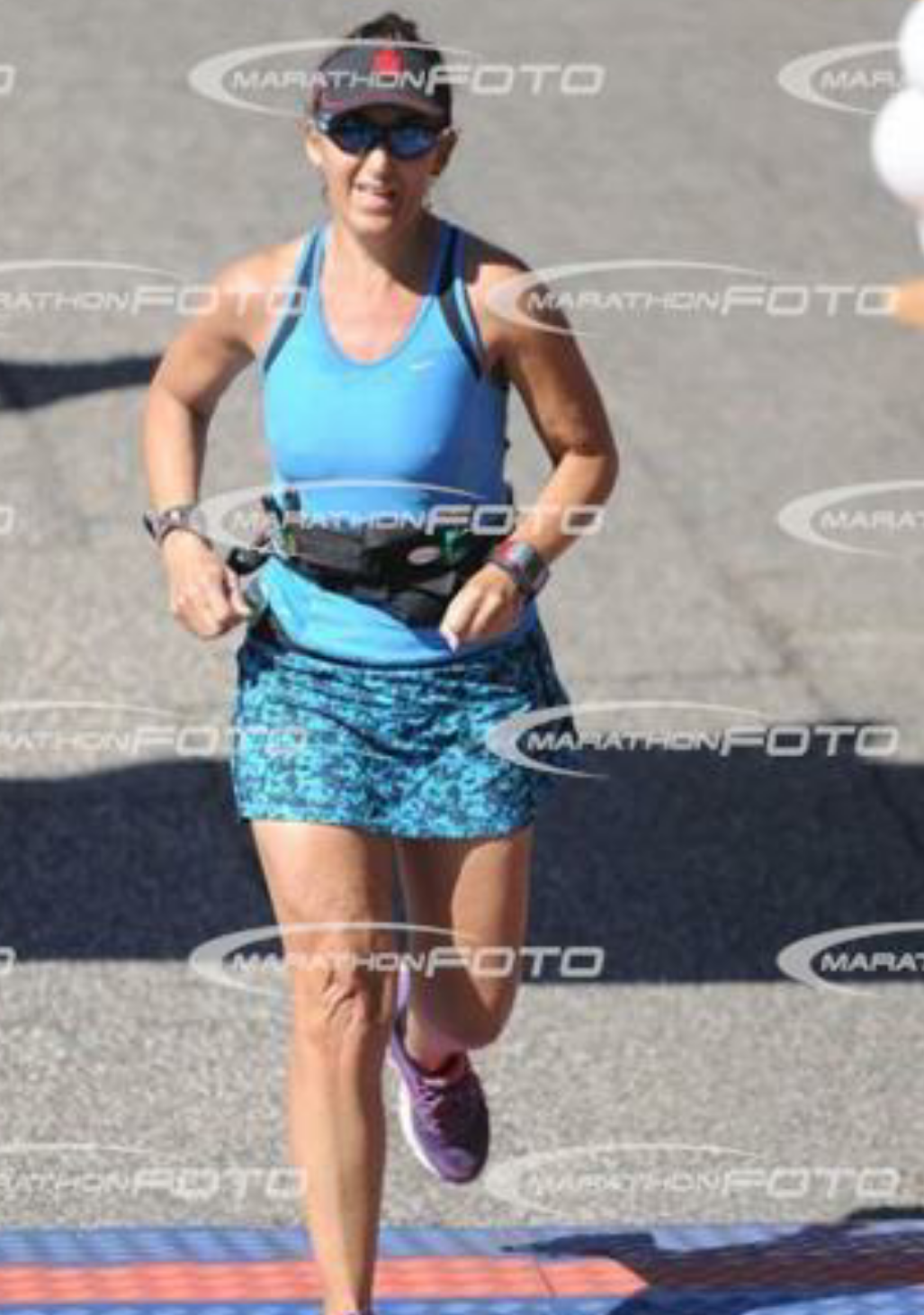
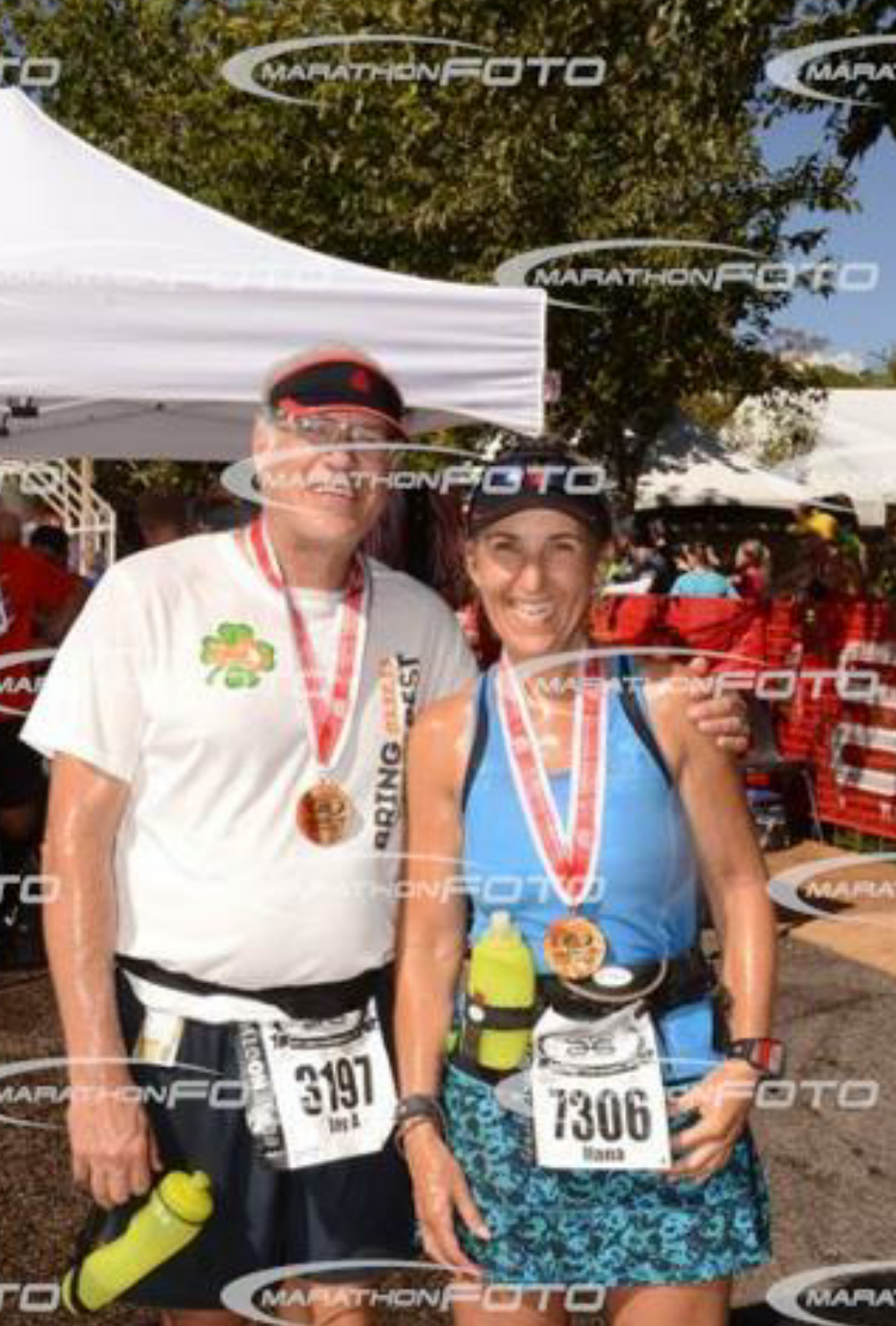
I was sorry I did not have my phone or a camera to capture the experience, because it was a great one. I do not have any good shots from the race photographer, because I was wearing too many race belts (fuel, interval timer, and race number all on different straps)  and all these straps tied around my waist – hence race number landed facing the back, and that’s where it stayed… co-ordinating race belts and still feeling comfortable is an oxymoron.  I have proof of all this in the marathonFoto proof:

(at least MarathonFoto captured one running pic, and one finisher pic).
marathon1

I have done a few marathons to date, and this one is definitely one of the more beautiful ones. It is very well organized from the expo, to the transport, to the start area, line up and finisher experience. It was an awesome plan B to a turned down NYC entry. I recommend it. And then being on one of the most beautiful states it is worth an extended trip to get in some scenic encounters.  I stayed on, accompanied by a couple of hiking buddies, we explored some of the well known National parks around Utah. From Zion, to Bryce, on to Canyonlands and Arches. Every one of these hiking days was unique, and completely different to the day before. Every wince (don’t forget I am hiking on marathon legs) was worth it.

The year of the Marathon take aways:

–          Never belittle your goals. There is no such thing as “just a marathon” similarly there is no such thing as “Just a 5k”

–          Mocha is the new salted caramel flavour

–          Utah is gorgeous.

–          St. George is a great plan B, if not even a Plan A, for a marathon bucket list item.

–          Utah is cold in the early stages of Fall.

–          I pronate on a downhill run (and paid for it via ankle swelling and bruising all through my hiking week)

–          Downhill is just as hard as uphill, I swear!

–          Elevation maps with tiny scales can be deceiving

–          I am still good at sports nutrition 😉   – great marathon, finished strong, even though it got hot in the end.

–          Hello, my name is ilana… I am an endurance junkie

ilana-in-bryce


FUEL YOUR WORKOUTS!!

Did you know that most recreational athletes that sign up for an endurance endeavor with a main goal for weight loss, are in fact flabbergasted that even with the increased physical activity, weight loss does not come easy, in fact many even gain weight. There are a number of reasons for this:

1. the positive reason is because the new athlete may be losing fat, but gaining muscle fiber. Muscle being denser than fat, offsets the scale from budging, but the athlete is getting leaner…

HOWEVER, this is not the case for every new athlete – many actually gain more fat – the common reasons:

2. Offsetting the calorie burn with calories consumed (in other words a calorie deficit is not created even with the many extra hours of training)

3. Not fueling properly – many athletes trying to lose weight decide to skip the pre work out calories, and the during work out calories thinking they will burn more fat this way, or that they will have these calories after the work out anyway, so why have double?
– research shows that athletes who do not fuel their workouts land up eating way more calories post work out than they would have if they fueled earlier.

REMEMBER: without fuel you will not burn fat… glycogen (immediate source of energy) that comes from carbs, is required to create the flame for fat to burn in… without consistent replenishing of glycogen, fat will not burn effectively. This ultimately results in muscle burn instead!!

So enjoy that pre work out carb!! what are some of the pre work out meals you find work best for you…


HEMP – alternative protein that is nut free, soy free, and dairy free

HEMP – An Alternative (and vegan) Protein Source

Since my meal planning philosophy typically embraces a breakdown of nutrients at both the micro level (vitamins and minerals) and the macro level (carbs, proteins and fats) I often get asked for alternative sources of protein than the most obvious (beef, chicken, fish, eggs). If I did a family feud type survey, out of one hundred answers soy or tofu would be the number one answer. We may whittle down to pea protein or other legumes and then of course nuts. It is not often one hears of hemp. Most refer to it as a side ingredient to muesli or granola but have yet to categorize it as a vegan alternative protein. More recently, Hemp has been classified in the superfood group and even healthier fare restaurants like Sunflower Café, or True Foods have it showing up on many menu selections. Before we know it, the more common restaurant chains are going to catch on… and for good reason!

A Medicinal view point

Interestingly enough, hemp seeds are related to a marijuana plant, as both originate from the Cannabis plant. The difference is that hemp does not contain the active compound called THC that marijuana does. THC is the secret culprit for producing the ‘high’ effect. Instead, the micronutrient panel of Hemp includes a good source of iron, magnesium, potassium, calcium and phosphorous like all good proteins do. It also is a rich source of vitamin E which is considered a powerful antioxidant.

At the macronutrient level, Hemp seeds are considered a good source of plant based protein with 2 tablespoons providing 5 grams of protein. The rest of the 90 calories in these two tablespoons are made up of 2 grams of fiber (placing hemp into a high fiber group) as well as 6 grams of good fat and 3 grams of total carbohydrates. Hemp, is naturally sodium and cholesterol free.

Although I am yet to study marijuana in its planted based form, I somehow doubt that the marijuana plant can claim all this 😉

How to use it

Hemp has a nutty like flavor that will work in a diversity of recipes, from sweet to savoury. They can be eaten raw, and are often found in sprouted form whether ground into a meal/flour or a raw grain in health breads.

Hemp can be simply sprinkled on oats, yogurts, soups, salads, stir fry’s or stews. They also work well in flavoring some old favorite recipes like pasta sauce or even to replace pine nuts in pesto based dishes.

Hemp can also be found in a powdered form or a hemp milk form for the specific use as a protein substitute and is therefore good in smoothies and protein drinks. Hemp milk can even replace dairy based milk for drinking or in vegan recipes requiring a dairy substitute.

Hemp seeds also can be pressed to produce an oil base, good for dressings and drizzles over salads and vegetable dishes, however it is not good for cooking since it has a fairly low smoke or burn point (therefore should not be brought to a high temperature).

Storage

Hemp seeds, powder form (mealed), hemp milk and oil can all be stored safely and thus purchased in bulk. Be aware however that hemp is in original form, a seed, it thus oxidizes. This translates to storing in airtight containers and kept in a cool, dry place (preferably the fridge) to keep oxidation to a minimum.

In Summary

This newly classified superfood called hemp, popping up on restaurant menus and many health magazine recipes, can provide a great addition to a variety of foods and offer a diversity of flavor and nutrients simultaneously. From serving with hot or cold cereals, to baked breads, muffins or other bakery items, it also offers a healthy ingredient in dressings and sauces. For vegans it is a good source of protein, and in particular it is a great substitute for all that may be looking for a soy free, nut free and/or dairy free option.


 pumpkin seed bread
(18 servings of 1 slice each)

1/2 cup whole grain flour
1 cup sugar
1 tsp baking soda
1 tsp cinnamon
pinch salt
1/2 tsp baking powder
1/2 tsp nutmeg
1/4 tsp ground cloves
2 eggs
1 cup mashed pumpkin (from can is fine)
1/2 cup hemp seed oil
1/2 cup water
1/2 cup hemp seeds (shelled)
1/2 cup mixture of options (nuts, dried fruit, etc0

Combine flour, sugar, baking soda, cinnamon, salt, baking powder, nutmeg, and cloves in a large mixing bowl.
in a separate bowl whisk the eggs, add pumpkin, oil and water. Mix well.
Stir wet ingredients into dry ones. Fold in the hemp seeds and other options (nuts, dried fruit, etc)

Spray a 9 x 5 ” pan with pam. pour in batter. bake at 350 degrees for approx 1 hour or until baking tester comes out clean.
Cool on wire rack.

Mango Ginger Salsa Chicken – ILANA’s Recipe

Salsa is great substitute for other marinades, offering a medley of flavours with a lower salt content yet tasty and nutritious too.

Grilled Mango-Ginger Salsa Chicken

(4 servings)

Time saver tip: Peeled and cut up mango is probably available in the produce section of most grocery stores. (Nothing wrong with peeling and cutting up mango yourself as a money saver though).

Ingredients:

4 boneless, skinless chicken breast halves (~ 4oz each)

1 Tbsp olive oil

1 tsp curry powder

1 tsp brown sugar

½ tsp coarsely ground black pepper

¼ tsp salt

1 lemon cut into 4 wedges

Olive or canola oil spray

Salsa:

2 cups finely chopped mango

3 Tbsp chopped fresh mint leaves

2 tsp fresh ginger, grated

¼ cup finely chopped red onion

1 tsp lemon zest

2 Tbsp fresh lemon juice

2 tsp olive oil

Directions:

  1. Rinse chicken breast halves, pat dry and flatten to ~ ½ “ thick.
  2. Combine 1 Tbsp olive oil, curry powder, brown sugar, salt and pepper. Brush over chicken and let marinade for ~ 15 minutes.
  3. Meanwhile, stir together salsa ingredients in a small bowl.
  4. Spray a pan with olive oil or canola oil spray and place over medium to hot stove plate. When oil is hot, add chicken breasts. Cook them for ~ 4 mins on each side or until they are no longer pink inside and juices run clear. Transfer breast halves to a larger platter. Squeeze lemon juice over chicken, serve with salsa.

Nutrition per serving (1 chicken breast half and ½ cup salsa):

Calories: 215                Cholesterol: 65 mg

Total fat: 7g                  sodium:  175 mg

Sat. fat 1g                     total carbs: 11g

Trans fat: 0g                     fiber 1.5g

Protein 25g                       sugar 9g

Metabolic Efficiency: Who Needs it?


As a sports dietitian, as well as an endurance athlete
(triathlon and marathons) that struggles to lose weight, I often find myself
frustrated with the low response my body has to my consistent training and very
disciplined eating habits. I also have many athletic clients that struggle with
the same dynamic. I thus began to research the concept of “Metabolic Efficiency”,
defined as “Energy intake based on body weight that is required to maintain
current weight.”  I even went as far as
having a basal metabolic rate test done, only to discover mine was off the charts
(low).  This demonstrated to me that just
to maintain my current body weight (without gaining), or to drop even a minimal
amount, required less energy (calories) than my already restrictive daily
intake even with an above average of training hours per week. So what then is metabolic
efficiency and does it exist? Am I that efficient as a machine – that I do not
need much fuel, even with a high demand of training hours. Maybe I am the new
model of “green,” the “Prius” of the athlete model. Yes, metabolic efficiency
seems to have a positive ring to it, but it can be an especially frustrating
state for those that seek weight loss as a benefit of endurance training.

This is not a new concept. In fact, in the early 80s,
researchers highlighted the potential for energy efficiency among athletes when
many competitive athletes reported what would seem to be inadequate energy
consumption to meet the demands of their excessive training regimens.  (Drinkwater, Deutser, Dahlstrom, Beidelmann).  Based on the energy balance equation (energy
consumed equals energy expended), one would expect these athletes not only to
jeopardize their performance with such low intakes, but to drop weight
drastically. However, evidence showed that triathletes, gymnasts, marathoners
and distance swimmers maintained their body mass over extended periods despite
low energy intakes (less than 35 calories per kilogram of body weight). Thompson
et al, studied 24 endurance athletes with the same number of hours of training
in a week.  Some of the athletes
typically ate less than adequate energy and others had above adequate energy
for their training demands (there was a difference of almost 1500 calorie per
day intake between the two groups). Thompson’s results definitely leaned
towards metabolic efficiency existing, because regardless of the difference in
energy intake, both groups’ body composition (body fat and muscle percentages)
remained stable for over two years.

One could easily argue that what athletes reported as
intake, may be under-reported. This in fact, is a common phenomenon, particularly
in athletes of aesthetic sports, where body image distortion runs rampant.
Wilmore and Schultz measured energy expenditure in female runners in a
respiratory chamber. Their experimental group reported significantly lower
energy intakes than their training would require but the measured energy
expenditure showed no evidence of metabolic efficiency. In these studies,
metabolic efficiency has a more objective, physiological definition: a lowered
resting metabolic rate and an increased energy expenditure during intense
activity. In similar studies, Beidelmann in 1995, like Wilmore and Schulz, found
no significant changes in resting metabolic rate or energy expenditure (rate of
oxygen consumption). With this definition secured, the only conclusion these
researchers could draw, was that the runners were under reporting energy intake.

Thompson et al, argued for metabolic efficiency again in his
1995 research. Here he set out to determine if activity energy expenditure,
sleep energy expenditure and resting heart rate in endurance athletes were
similar over a 24 hour period rather than an extended time, and also measured
oxygen consumption in a respiratory chamber.
Surprisingly, lower energy-intake athletes (low again by almost 1500
calories of estimated energy requirements for the experimental activity) had
physical energy expenditure, resting metabolic rate, and sleep energy
expenditure lower than the adequate-intake athletes. Furthermore, he controlled
the athletes’ intake, thereby preventing over or under reporting in this short
duration.

My initial perception of metabolic efficiency (very slow
metabolism) was now totally upended by this research.  Perhaps I underreported my food intake oroverstated my levels of activity.  The research found that many physically active people are more sedentary in the non-exercising portions of their day which would negate the perception of less energy intake would lead to a drop in body mass. To take this even further,
athletes (particularly ones that are highly competitive, or involved in high
intensity endurance sports) typically have an extended recovery season when
their much training regimen decreases, as compared to their short (probably 2
or 3 months at the most) peak season.

In most of these studies, resting metabolic rate, energy
expenditure during exercise, and an average of daily energy expenditure
provided the measure of metabolic efficiency. These measurements of metabolic
efficiency can be helpful for many, especially athletes in aesthetic sports who
can justify eating less yet still perform effectively. For endurance athletes,
it may take longer for them to “hit the wall” as they burn less calories and
spare more glycogen during their events. However, for many recreational
athletes, often choosing to participate in a sport for the benefit of being
able to eat more and still lose weight, metabolic efficiency may result in
frustration unless they have a deeper understanding of the concept. Based on
experience with my recreational athlete clients, many often think that training
will allows them to eat more. The research above helped carve out a good
summary for these athletes: unless metabolism is raised simultaneous with
training, weight gain is more likely to result versus weight loss.

A higher metabolism means a higher consumption of oxygen,
the rate at which the body burns calories. This includes at rest and during
exercise. Duration, intensity of workouts, as well as body composition and food
consumption, not only determine calories burned during workouts, but also
calories that continue to burn post work outs. Exercise itself is the highest
contributor to increasing ones metabolism and those of us wanting to reverse
our efficient metabolisms may need to take a closer look at how we work out.
Our diet does contribute to overall metabolism (calories burned based on
composition of macronutrients/ the thermic effect of food) but to a lesser
extent than exercise.  Whether it is a
high intensity aerobic workout or a lower intensity longer duration work out,
or even a muscle building weight lifting session in the gym, all of these
contribute in some way to raising one’s metabolism. Our metabolic rate also
affects the rate at which we burn calories at rest, a concept referred to as
“excess post exercise oxygen consumption” or EPOC.  So am I really metabolically efficient, or do
I need to look at the big picture: measured Oxygen consumption, an exercise
routine that maximizes EPOC, journaling and calculating energy intake versus
energy expenditure instead of estimating it?

bike

References:

  1. Beidem BA, et al. Energy balance in female distance runners. Am J Clinical
    Nutrition. 1995;61:303-11.
  2. Dahlstrom M, et al. Discrepancy between estimated energy intake and requirements in
    female dancers. Clin Physiol 1990; 10: 11-25.
  3. Duester PA, et al. Nutritional intakes and status of highly trained women runners.
    Fertil Steril 1986; 46: 636-43.
  4. Drinkwater  BL, et al. Bone mineral content of athletes. N Engl J med 1984;311:277-81.
  5. Fitzgerald, Matt. Running Hot. The facts and fallacies elevating resting metabolism.
    2009. www.poweringmuscles.com.
  6. Schulz  LO, et al. Energy expenditure of elite runners measured by respiratory
    chamber. J Appl Physiol 1992;72:23-8.
  7. Thompson JL, et al. Resting metabolic rate and thermic effect of meal in low and
    adequate energy intake in endurance athletes. Intl J Sports Nutr
    1993;3:194-206.
  8. Thompson JL, et al. Daily energy expenditure in male endurance athletes with
    differing energy intakes. Med Sci Sports Exerc 1995;27:347-54.
  9. Wilmore JH, et al.Is there energy conservation in distance runners? J Appl Physiol
    1992;72:15-22.