How to Keep a Food Journal

The number one complaint about keeping a food journal is that it is too much work for your busy schedule or that it makes you think more about food. Both of these are probably true. In the beginning, however, driving a car was a lot of effort. Eventually it became second nature and now you can probably drive while eating. By using either of these tools you can also update your food journal while in your car. (not while driving of course )

Keeping a food journal will help you improve your eating habits. No doubt about it. You can’t manage what you can’t measure. It is an old management adage that is just as meaningful to your weight control. Unless you measure something you don’t know if it is getting better or worse. If we are going to be able to help you with your weight management, we need to be able to see what you are eating and when you are eating it. SO.. we are going to do this thing, let’s make it as easy and fun as possible.

There are various apps on-line that regulate your fitness and food journal. They typically let you track what you eat with a few clicks – almost no data entry and record your workouts in minutes. Some examples are FitBit, MyNetDiary, Livestrong, MyFitnessPal, etc.

TweetWhatYouEat  is another on-line food journal – stripped down to the bare necessities.  If you use Twitter, this is incredibly easy to use.  You sign up with the service and then, using your Twitter account, send a direct message every time  you eat something.   Like this:

DM TWYE 2 eggs, spinach, olive oil

That’s it.  When you go to your TWYE diary, you will see a list of everything you entered.  The calorie counts are “crowdsourced”,  meaning that other users have given “2 eggs” a calorie count and TWYE uses that in your calculation.  If you don’t like the calorie count they used you can edit it.   TweetWhatYouEat gives you a total for the day.
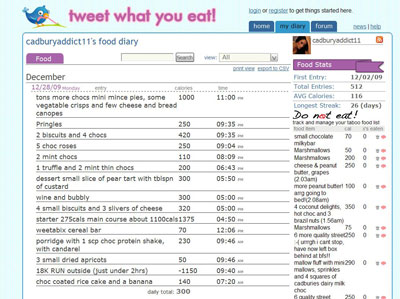
You can use either of these services to send  food logs to your nutrition clinicians, or merely just for self accountability.

If you use Twitter, feel free to follow me on Twitter for our latest tips @ilanakatz.  I try to post neat stuff to share with  Twitter friends frequently.  Or of course Facebook too “Optimal Nutrition for Life – by Ilana”.
Planning Your Meals

thinmanrunmarathon

In my practice,  I find the biggest roadblock to weight loss success is that people do not take the time to plan their day as far as eating goes. So they either wait for meal times, or until they are hungry, and then just see what is convenient to grab.

This sets you up to  either not eat enough during the day, or gorge on whatever is available, or just get the most convenient food which is more than likely prepackaged and processed.

If you take a few moments in the day to plan a grocery list, spend an hour or two a week shopping for nutritious foods (that can be just as convenient), and having these nutritious foods available for eating smaller meals more often during the day – the huge high calorie, high fat, or prepackaged meals can be avoided.

Planning is the best tool for success in any project, and creating a healthy lifestyle and/or weight management is a project too. Planning is not a big deal – in fact, shopping regularly and having the right type of foods available means the planning is done.

Nutritiously dense and calorically low foods that are easy to have around are things like yogurts, string cheeses, whole wheat crackers, ricotta or cottage cheese, wheat tortillas and sliced turkey, carrots and other veggies, V8 fruit and vegetable juices, raw nuts, some trail mixes (not all m and m’s), meal replacement bars, fruits, hard boiled eggs (when ready to eat peel, and discard some of the yolks), hummus (to have with some of these), 100 calorie snack pack to enjoy once a day, such as pretzels, baked chips, etc.

Many of these things can be kept in a mini fridge at work if available, else have ice packs available and pack a mini cooler for a days worth of snacks, and many can be kept in a desk drawer, trunk of the car, if not necessary to refrigerate.

green

FUEL SAFE ZONE

protein cookies

protein-cookies

1 c (4 scoops) vanilla whey protein powder

1 c almond flour

1 c almond butter

1½ c unsweet applesauce

1 tsp vanilla extract

1 tsp baking soda

½ tsp salt

sweetener optional, and for taste: Recommend to use a stevia based one and about 1 Tbsp is perfect amount for the recipe.

Mix all ingredients together in a bowl. Use as a batter and shape into cookie size on a baking sheet (3″ diameter, can roll into a ball and press slightly down to flatten).

Bake at 350 for 5 – 6 minutes, right as turning dark tan color.


RESOLVING TO BE A BETTER TRIATHLETE

Ilana Katz MS, RD, CSSD (a partner in crime)

Just the other day I was pleased to see a whole bunch of 5:00am-ers waiting for the gym doors to open. The regulars were there too, most of them with their eye roll to one another (translation: “these new folk will be gone before the next cold days emerges”).

According to Time.Com. the most broken resolutions are related to diet and exercise.  So why then do people keep making the same resolutions and breaking them year after year? More importantly, what can we do to make this year different?

So how well did you fare?… as we are heading towards the end of January, the 5:00 am line at my gym has petered down to the regulars. I guess I am preaching to the choir (talking to dedicated athletes does have more of a curve shift) however, are your triathlon goals still in check?

With February being on the horizon, this may be the best time to reevaluate what your goals are.  Maybe you set yourself up to fail with an unrealistic outcome.  Losing 20lbs in a month doesn’t really seem reachable after reality sets in.  It’s ok to modify your resolution and make a goal that is achievable.

Depending on your answers to above, it may be time to step up a new plan of attack. You do not have to wait for New Year to resolve.

Here are some triathlete specific examples:

  1. Partners in Crime

Get some help.  Knowing that someone will be there with you results in a sense of accountability.  Maintaining a healthy lifestyle can be difficult, especially if you have been racing and training hard for some time and have reached burnout.  You can’t have a friend be at every training session or watch everything you eat but working with an expert can help with this solution.  Studies from the American Psychology Association have shown that using partners enhance success. A coach can help with sticking to a plan, or a nutritionist can help make a realistic meal plan and most importantly help implement it.

  1. Race specifics

Have you been contemplating the challenge of taking on a longer distance or more challenging race?

Perhaps you have already accomplished sprints and Olympics but the 70.3 or full ironman seems too much to take on. Or even if you have completed the distances, a more challenging course or different destination looms on your mind. You will not check off that box until you commit, establish your goal, and implement.

Don’t forget, the more endurance you decide to take on, the more important sports nutrition and other supporting tools become. There is a whole new realm optimal race weight, eating for competing, and fuel and recovery as you head towards ultra-distances, therefore see #1 (partners in crime).

  1. Resolve on your performance hindrances

For every athlete, there are always areas that need improvement, Particularly with triathletes who tend to focus on swim, bike and run and neglect other areas such as

  • Haphazard nutrition (of course I am biased about this one)
  • Unnecessary body weight (yes, this one too)
  • Rest and recovery (and yes, there is a nutrition spin in here too)

And then some training areas that can always use some extra resolutions:

  • Core strength
  • Flexibility
  • The challenge of the hill/mountain
  • Rest and recovery
  • Random training (goes hand in hand with nutrition being haphazard)
  • Limited knowledge

And then there is mileage. Perhaps putting in the necessary mileage week after week could be a great resolution, merely because we tend to get bored and cut workouts short.  Determine the mileage necessary to hit each week and improve on the limiting factor.


  1. Resolve your performance challenges

Once you are a regular and comfortable triathlete, a great resolution could be to challenge performance levels. Some good examples are:

Hit certain PRs

Place in age group

Complete a run portion in a challenging minute per mile

Complete a bike portion with a higher than your typical average miles per hour

Be the first out of the water in age group

Aim for a Boston qualifier or a Kona place

  1. Deal with burn out

It may be the case where life over and above triathlon may have taken a backseat. Some may resolve merely to regroup on motivation, enjoyment, and inspiring others within the sport.

For many, a great resolution to consider would be to be relieved of the stress of competing and focus on the enjoyment of the training and thus completing without the competitive anxiety.

Some ideas here may involve connecting a race with a fund raiser and focus on raising money for a good cause. Or merely involve your family in a relay event.

Burnout may also be related to insufficiency of the right nutrients or over abundance of the wrong fuel sources. Work on meal planning (and again, see #1: Partners in crime).


Tips for success:

  1. Plan ahead

Every good triathlon plan includes set goals, objectives, training hours, race priorities, etc. Coaches and sports nutritionists are on board to help and they will insist the plan is set up in the early stages of training for a target race.

  1. Be SMART about your goals – Specific, Measurable, Achievable, Realistic, and T

For example:

A resolution of “lose weight” is not specific.  A specific goal would look more like “hit my target weight before my first A race”.

A resolution of “have more fun” is indefinable. It may be better to state a stress-free environment, with a focus on social aspect of your tri club for example.

  1. Maintain Positivity

For example: “do not mess up swim to bike transition” phrase rather as Transition one in under 5 minutes

OR “do not get injured” should be stated as follow designed coaching and nutrition plan to avoid injury.


  1. If you want to accomplish a goal – share it!

The odds of success for any goal is if others know what you are aiming to accomplish. Not only is there a backup support system, but there is also the commitment and accountability once it is aired.


Happy February y’all…. Now get on it and get your partners in crime lined up!!

Low Carb equals Low Energy

We have been  living in a low carb revolution, but thank goodness it is slowly emerging back to normal. Dr. Atkins was one of the for fathers of this phenomenon. One cannot leave out Barry Sears of The Zone fame, either and somewhat more recently, The South Beach diet, and Paleo diet, for the continued population growth of the carb-limiting fanatics. They are still out there, I come accross it in my practice everyday. But with the emergence of more endurance athletes, and triathlon, there is more of a focus on a balanced amount of good carbs with an appropriate amount of good protein, for good reason.

Books like Dr. Atkins, The Zone, Good Carbs, Bad Carbs, and the South Beach Diet claim that we can blame the obesity epedemic in America on carbohydrates. These low carb philosophies claim that certain carbohydrates cause a quick rise in blood sugar which in turn raises insulin levels. They further claim that insulin leads to weight gain by either being a promoter of stored fat or by reactive lowered blood sugar level, stimulating hunger, and thus encouraging over consumption of calories. Unfortunately, it is in our culture to grasp on to quick fixes. Granted, there are metabolic reasons why one can lose “weight” on high protein (low carb) diets, which has thus claimed this carb-restriction revolution. Publishers and marketers knows what sells resulting in the low carbohydrate diets being popularized without detailed evidence of their efficacy or long term safety and athletes are getting caught up in the low carb frenzy. The quick weight loss from limiting carbohydrates is just that – a quick fix. Athletes however, should really take note how surprisingly few scientific-based studies have shown how different carbohydrates affect weight loss. Furthermore, there is no clear evidence that a rise in blood sugar that comes from eating carbohydrates leads to an insulin increase, or that higher insulin causes people to overeat.

Although these quick fixes, regardless of the lack of scientific knowledge, are welcomed amongst significantly overweight, sedentary people, they were not designed to supply the nutrition for active people who need to support exercise and training. While low carb, quick weight-loss results are welcomed, athletes should regard these same “quick fixes” as lost energy. The initial and rapid weight loss from low-carb diets can be explained as glycogen depletion and loss of water weight. Glycogen (immediate source of energy in muscle) in the body is stored with 3 grams of water. So, each gram of carbohydrate energy, then, accounts for 4 grams of body weight. By limiting carbohydrates, glycogen will be used as energy first. For an athlete, glycogen depletion can take as little as a few hours, whereas for a sedentary person, glycogen depletion can take up to a few days.

Once glycogen stores are depleted, the body seeks out fat and protein sources for energy. First it turns to protein, converting amino acids from muscle tissue into glucose in the liver. This process is relatively slow and can produce only enough carbohydrate to fuel the brain and nervous system. Without ingestion of additional carbohydrate, ketone bodies (byproducts of fat metabolism) are produced and released into the bloodstream. A state of ketosis is induced. Ketosis is explained as an increase in ketone levels. Ketones in the bloodstream does suppress the appetite, but is also be accompanied by undesirable side effects, such as nausea, headaches, fatigue, and breath that smells like ammonia. Athletes on low-carb diets have difficulty sustaining even moderate intensity workouts of 50-65% of max heart rates when ketone levels are elevated.

In summary, the low carb philosophies demand a restriction of the very elements that athletes need to powers muscle with energy – digestible, usable, and absorbable carbohydrate. Carbohydrate is fuel for muscles that can be burned quickly, providing the power for acceleration and high performance.

Resources:

1.Advances in Sports Nutrition. Journal of American Medical Association. JAMA 2003;289:1837-1850.

2.How net carbs can hurt athletes. Ashley Kipp. Published on trainright.com, accessed October 2004. 3.Weighing the Diet Books. Nutrition Action. January 2004, volume 31:1.