Breaking Evening Munchies

pot2

There are a few simple steps you can take in the day to ward off evening food binges.

It’s practically an American tradition. After a hard day at work you come home, plop yourself down in front of the television and start eating. A bag of potato chips here, a pint of ice cream there. By the time the late night news comes on, you’ve put away a day’s worth of fat and calories in just a few hours.

Fortunately, it doesn’t have to be this way. There are a few simple steps you can take in the day to ward off evening food binges. First, eat your breakfast, like your mother always told you. When people eat late at night they wake up full.  Then they skip breakfast, which starts the cycle of not eating properly throughout the day.

Eating three square meals will help keep your blood sugar stable so you won’t feel famished at night. And don’t forget the power of snacking. Eating smaller portions in more frequent intervals, helps stave off hunger while ensuring that your body receives a steady supply of nutrients.

At work, try to keep a bag of trail mix, fruit or other healthy snack within arm’s reach. This will help you avoid that other American tradition, the enormous lunch. And snacking helps you stay alert. As everyone who’s ever nodded off at the computer in the afternoon can tell you, large meals tend to make you tired.

Try to avoid the empty calories of soft drinks and the high fat content of salad dressings, butter and margarine. Contrary to popular opinion, a healthy diet doesn’t have to mean sacrificing treats. In fact, depriving yourself during the day is one way to set yourself up for disaster at night. Enjoy a cookie or small portion of dessert after lunch or dinner. This will satisfy your sweet tooth without putting you over the top in fat and calories.

Since most of us can’t make it from dinner to bedtime without a trip or two to the kitchen, it’s a good idea to have an early evening snack. Stick with light carbohydrates, such as cereal, a piece of fruit or whole grain toast with a bit of jelly. This will keep you from waking up at night with a craving for a pepperoni pizza. Try to limit the amount of time spent in front of the television at night, as all those commercials for junk foods tend to whet the appetite. Reading, crossword puzzles, or exercise are good alternatives.

Since you can’t eat it if you don’t buy it in the first place, limit the amount of junk food you bring home. When you go to the supermarket, do so on a full stomach. Those aisles lined with pies, cakes and potato chips are a lot more tempting when you’re hungry. Remember, if it isn’t it your cupboard or refrigerator, then you can’t be tempted. Don’t forget to include some exercise in your daily routine.

Exercise helps burn calories and improve metabolism. In fact, exercise raises your resting metabolism, so that you’re burning more calories even when you’re not doing anything.

And finally, don’t try to accomplish everything overnight. By focusing on making small improvements in your dietary habits, week by week, you’ll make lasting progress. For instance, you could start by replacing the daily bag of potato chips with a piece of fruit. And be sure to talk about your goals with family members and friends. Telling other people about your goals helps to increase your resolve.

tread

Carbo loading as part of a Runner’s Diet – Defined

Start of Marathon

Start of Marathon

Marathon season is almost in full swing, and those of you training for fall marathons are probably doing long runs in the mid to upper teens at this point. I find the most common question I get from endurance athletes relates to the traditional pasta dinner the night before a marathon. For one thing, does it really increase performance?

I thought I would share my knowledge and experience on carbo-loading, whether it is just tradition, or if it really does offer the performance benefits sought by many athletes. Furthermore, now that there are so many different types of pastas on the market, I wanted to give you the low down on what may be best for your individual needs.

To lay the foundation, I define carbo-loading as increasing your intake of carbohydrates so that muscle glycogen is maximized, which boosts endurance for distance.

Healthy Runner’s Diet – Carbohydrate Loading Defined

The traditional method of “carbo-loading” involves a stage of prolonged exercise and an exceedingly restrictive diet called depletion, which is then followed by intense carbohydrate loading. More recent research suggests that intense exercise during depletion followed by excessive glycogen storage could lead to muscle trauma. This in fact would impair the storage of glycogen rather than enhance it. Other side effects that follow this method include bloating, added pounds, which not only causes you to feel drained and uncomfortable, but also increases injury risks. Personal records could be compromised under these conditions.

A more modified approach would begin a carbo loading regimen one week prior to the event, by tapering training mileage and shifting more of your total calories to carbohydrates, decreasing the amount of fat and protein as the week progresses. In other words, two days prior to your endurance event, you will not be eating mostly carbs and very little fat and protein. Carbo loading means simply shifting the percentage of the macronutrients to a higher carb intake. It  does NOT mean load up on every carbohydrate you can lay your hands on. The reason this modified approach works is because the tapering in exercise simultaneous to an increase in carbohydrates boosts glycogen storage as effectively as depletion and loading, but without the negative side effects.

So to answer the question whether the pasta dinner the night before is optimal or not Continue Reading »

White Flour = Empty Calories

History of White Flour

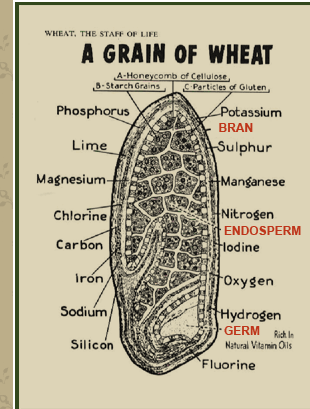
Prior to 1900, most bread was baked at home with fresh flour. Our grandmothers and great grandmothers would go to the miller and buy fresh flour, or they would mill it at home themselves. In the late 1800’s however, food processors discovered if they sift away the BRAN and the oil-laden GERM from the flour, they’d have a product that would not spoil. (see diagram)
White Flour is Poisin? Steel rolling mills quickly replaced the local miller, and in 1910, white flour became food for the masses. Immediately epidemics of beri-beri (Vit B1 deficiency, nervous disorders), pellagra (GI disturbances) and mental insanity broke out. I like to tell people that you know if you are not getting enough oxygen because you can’t breathe. But when something more subtle, like Vitamin E, is removed, you don’t know it and the consequences of eliminating it from your diet are devastating.



So America was struggling and eventually researchers traced the epidemics back to the nutrients removed from the bread. They went back to the millers to urge them to put the BRAN and GERM back in the bread. However, they chose instead to “enrich” the flour by returning only four of the original 30+ nutrients removed.

A simple wheat berry is packed with vital nutrients. The wheat berry consists of 3 parts: the bran, germ, and endosperm.

BRAN: hard outer layer of the wheat berry that protects the nutrients within and is our richest source of fiber. Once this protective layer is cracked, the nutrients begin to oxidize immediately. The purpose of fiber in our diets is to cleanse; we have a remarkable sewer system, but it needs fiber to perform. The job of fiber is to absorb water. As it absorbs water in the colon, fiber increases in size like a sponge. This increases the bulk of our stool, which causes pressing on the walls of the colon and gives us the urge to eliminate daily. A diet without fiber results in no absorption of water, no increase in bulk of the stool, no urge to eliminate. This leads to constipation and a build up of toxins in our body that need to be eliminated.

GERM: life of the seed, where sprouts come from, rich in oils (wheat germ oil)and Vitamin E. The sole purpose of Vitamin E in our body is to protect our cells from being destroyed in the presence of oxygen (oxidation); Vitamin E is an anti-oxidant. Excessive oxidation in your body takes its toll, yet Vitamin E can neutralize the damage to your cells. When Vitamin E is deficient, cells break down or are oxidized faster than the body can reproduce. Vitamin E is needed by EVERY cell of your body to prevent disease.Yet with the complete stripping away of the perishable wheat GERM in 1910, the diet of western man lost its only single source of Vitamin E.

ENDOSOPERM: mostly protein and starch, devoid of any real nutritional value. This is basically the “white flour” we eat and was created by God, but He never intended it to be separated from the rest of the seed.

Important note: Unfortunately the American diet has very little BRAN fiber or Vitamin E. Even whole wheat bread and whole wheat flour we buy in the store has the GERM removed. The secret ingredient of healthy bread is the flour. True fresh-milled flour spoils very quickly. Once milled, the nutrients begin to oxidize and if not used, the flour smells like rotten eggs in 24 hours. Fresh milled breads do not have a long shelf life and must be refrigerated.

Source:  Full Cup Bakery, Atlanta, GA

W.O,D – Ilana’s Challenge!

Elliptical, treadmill and stationary bike rotation

– 45 minute work out

strong girl1

(starts with treadmill, then elliptical, and ends with bike)


Treadmill:  20 straight minutes.

Form: long strides and squeeze glutes at end of each stride.

Min 0 – 10: set at a pace of ~ 4.0 at 0% grade.

Min 10 – 20: 12% grade and pace at ~ 3.5, maintaining stride form


Elliptical:  15 minutes.

set program that is most like a consistent running stride.

Set level (resistance) at moderate (should be about 160 – 180 strides per min)


Cycle: 10 minutes

manual setting 3. Pedal hard (feel your hamstrings) for straight 10 minutes

athlete water


Quick review on Anti-Inflammation Nutrition

I have recently been asked many questions on whether the anti-inflammation diets really work. So while such diets may not target weight loss exactly, there is evidence that they aid in anti-inflammation, and weight loss may even be a secondary benefit. This makes sense because inflammation foods, such as processed or refined foods, sugary foods, white breads, and hig fat (particularly trans or saturated fat) foods are eliminated for anti-inflammatory responses.

I put together a quick summary to answer these basic questions.

Inflammation affects individuals differently.

From research, the main points taken out for a general anti-inflammatory diet include:

Eat plenty of fruits and vegetables

Minimize saturated and trans fats, but include mono/poly fats (eg olive oil, avocado, nuts, seeds)

Eat a good source of omega-3 fatty acids (Fish: particlarly salmon/tuna, flaxseed, chia,               walnuts, pine nuts, and/or omega 3 supplementation)

Avoid any processed food in particular white carbs ( pasta, white ricem refined grains).

Include whole grains and sprouted grains(brown rice, bulgur wheat, quinoa, ezekiel).

Eat lean protein sources such as chicken; cut back on red meat and full-fat dairy foods. (as a pesco-                   vegetarian, you are doing this already, thought ide mention, since including non-fat greek yogurt is fine)

Include herbs and spices, in particular, ginger, curry, and other spices can have an anti-inflammatory tumeric, chilli powders, cumin.

Dark chocolate is a good substitute for sweet and unusual cravings 😉

Is their research related to diet reducing Inflammation?

There is current research that does say it can, but they acknowledge that the anti-inflammatory diet needs to be studied more extensively to prove that it actually reduces disease such as heart problems.

A lot of the research show a correlation that the Mediterranean diet, has been and is associated with improved cardiac outcomes.

There is also evidence of disease risk reduction in the Mediterranean-style of eating, as well as how Asians typically eat (replacing red meats with more vegan/vegetarian style proteins)

Where some people are confused, is the ratio between the different Omega fats. Example, diets high in omega-6 and low in omega-3 is associated with increasing levels of cytokines — proteins released from cells that trigger inflammation — thus getting this balance is important with the ratio of Omega 3s outweighing the Omega 6s.

Guide: Omega-3, in doses of 3 grams or more per day, has been found effective in reducing morning stiffness and joint health.

Guide for Omega 6 foods to keep in plan, but lower than Omega 3s:

Soybean oil, most vegetable oils, but coconut oil , palm oil and olive oil are all relatively low in Omega-6.

Sunflower, Corn, Soybean and Cottonseed oils very high in Omega 6. (should be avoided if you want to get the ratio right)

Nuts and seeds are pretty high in Omega-6, but they are whole foods that have plenty of health benefits and are absolutely fine to eat. Many grain-based foods particularly processed foods, also contain significant amounts of Omega-6.

Bottom Line: The most important thing you can do to reduce Omega-6 and increase Omega 3 intake is to eliminate processed vegetable oils from your diet, as well as processed foods that contain them. Yet include the fatty fishes, nuts and seeds, olive oil, avocado.