WEIGHING IN ON WEIGHING IN.

ILANA KATZ MS,RD, CSSD
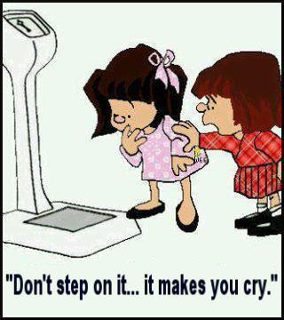
Is your scale the boss of you? Really, are you allowing this unforgiving, inanimate demon to constantly determine your moods? I ask this of many clients almost daily, and believe it or not, I get a defensive nod, and a “yes, of course!” Why people? Jokes aside, I do understand why, since I too have known to be a slave to a scale. Oh yes, and shamefully, I too allow that scaly, dumb thing determine my self worth. But I am done… I am ready to give you all a break. I am offering a plea bargain here – trade the scale in!! Open your mind, soul and mood-swings to more up-to-date, smarter devices, such as yourself,  mirrors, and clothes. Hey, I am not turning in my food police badge here, and neither is this a journal entry from my deepest, darkest soul search. This here is my curtsey to ol’ faithful science and Ilanalogic (an emerging scientifically evidenced phenomenon). Are you ready for the mind boggle?


To be fair, before I totally dis the scaly dumby, I will offer some credit, where credit is due. It is good for one thing, and that one thing is the determinant of scientific concept called gravity. Gravity, yes, the force that pulls objects towards earth.  In other words, if you were to weigh yourself on the moon which has no gravitational forces, you will weigh approximately only 20% of your current earthly weight. Moving to the moon seems to be a good weight loss option then, right?  Wrong! You will take yourself with you. If you have diabetes, you will still have diabetes. If you have high cholesterol, you will still have high cholesterol, Your body fat, will be your body fat. Ahhhh, but your weight will be less…mmm… would you still want to live on the moon with the same body fat?  (Darn, I guess I am not moving to the moon after all). So does that put the scale in its place yet? Do you now realize that when you lose 10 lbs in a week, or gain 3 lbs in a day, what you are losing or gaining is not fat, but simple a gravitational pull to the earth? It is in my nature to further define this gravitational pull to the earth, so that we can finally send all our scales to the moon (rather than ourselves).


Definition of weight can be “Ilanalogically” broken down into 3 distinct matters: Undigested matter, body water, and muscle mass. I dare you to study these each individually to get on my bandwagon. Firstly UNDIGESTED MATTER, known to the layman as poop  (I am not shy, dietitians speak of this daily, it is what we do.)  Undigested matter is created from the food we eat, so if we eat less on a day here and there, we will weigh less on a day here and there, since less poop will be created. Yes, all those unanswered questions can be finally put to rest, you know the ones: “is it possible to lose 2 or 3 lbs  by tomorrow?” Sure it is, just eat less today than you usually do, and matter of factly, you will lose a gravitational pull of poop to the earth. It may even be 2 to 3 pounds less if you eat that much less. Your metabolism has not risen suddenly, your body composition is mmm status quo, and your health has not magically improved over night.

 I hear you… many of you are itching to point out that I do not typically eat that much to begin with, so cutting back by 2 or  3 lbs of digestive matter in one day is not quite possible, huh? Well this brings me to my second component, and that is WATER. Did you know that 60 – 70% of your whole being is water? When you eat, the absorptive matter is attached to water which is transferred in the body. Do not forget, everything has weight, and every particle of weight is a component of gravity, and our scales measure gravity, in this case water.  Did you know the word carbohydrate means “glycogen” (storage of carbs) plus “hydrate” (the 3 – 4 molecules of water attached to the carbs). Quite mind boggling, huh?  So eat less carbs, and the initial response by your body is weight loss, because there is an absence of water that would normally be in those carbs.  Now eat hardly any food, in other words a low calorie diet, or a diet that does not equate in calories to your needed calories to survive (your basal metabolic rate), and what do you think will happen? Your body will begin to use up the glycogen stores to the point of depletion, and once again you will lose weight !! Let me be clear – this is not fat loss! You have not magically raised your metabolism, you have not drastically improved your health, and your body fat is once again, status quo.

 

This brings me to the third component of weight, MUSCLE. Unfortunately, the greatest component of weight loss, particularly on too-low calorie diets, is muscle mass.  Too low calories causes deprivation of nutrients, carbs, protein and also vitamins and minerals necessary for an effective metabolism. I say unfortunate, because loss of muscle also means loss of your most metabolic active tissue. Loss of metabolic active tissue translates into training the body to store more fat.  You may very well ask why do you not burn more fat in a state of deprivation. Although this seems like the a logical step, fat cannot burn unless there are carbs present. The by-product of carbohydrate metabolism is the oxygen in which fat burns.  Depriving yourself of the right amount of carbs will shift the body into finding the most available energy source for survival, and that is muscle.  Once again, you are losing something that has a gravitational pull to the earth – weight !!  And again, you have not lost any fat, you have not improved either your metabolism or your health… in actual fact, you have trained your body to store fat, and are going further and further away from the original goal of health and fat loss.  Literally, it would be to a point of no return, since muscle mass, although the easiest tissue to lose, is the most difficult tissue to rebuild.


So now back to the original question of what is the value of the scale (unless you have already thrown it away, in which case, good for you!!) No longer are you going to scream with joy and accomplishment when your weight goes down in one day (sorry I took that illusion away), but neither are you going to tantrum in defeat, failure  and wonder “why why why!!

I hope I have somewhat eliminated the awe of a 2 – 4 lb weight shift from day to day.  Ilanasology should have explained the normalcy of this, and it has nothing to do with fat loss.  If you are still not convinced that the 4 lbs you gained overnight is not fat, then get out your calculator:  One pound of fat is 3500 calories. This means that to gain 4 lbs, you would have to eat 14 000 calories, and although some of you may snicker, I doubt that you ate that for dinner.  Similarly, if you are convinced that the 4lbs you lost within a day or two is because you have been a perfect angel on your eating plan, then again, get out your calculator.  Realistically it is viable to lose 1 – 2 lbs a week but a 10 lb fat loss in one week would equate to a 35 000 calorie reduction over the week. Not really rational, is it?

 So now that the technical stuff  has bogged you down, there is one simple take home focus, and that is that you can realistically lose 1 – 2 lbs of fat a week. With that said, if you are not willing to give up your dysfunctional relationship with the scale, at least consider “dating” the scale. And by that I mean, set up a date or two with the scale, play hard to get, keep your distance, and do not let that dumby become a mood swinger. Keep the scale at bay, and date night should be at max once a week. Well, maybe not date night, since the dumby is more effective in the morning. Weigh in at the same time and under same conditions on each date, meaning no clothes.  Always put yourself first! No really – YOU are your best critic for your success and continuous motivation. Look in the mirror,  pinch your firmer muscles for a reality check. Do you feel good. Are you feeling fit and healthy.  Get in touch with your feelings, since they are the real proof in the pudding (and no, not mmmm pudding). Are your rings slipping, is your skin feeling tighter, are your muscles shapely, and do your clothes feel loser.  You know when you are eating well, sleeping optimally, de-stressing. So never let your scale tell you any differently!


Ways to use Whey

Whey protein is typically known amongst the work out crowds as a lean muscle recovery protein. It works hand in hand with the breakdown of muscle during the work out to rebuild and repair those muscle fibers. However, whey also has its place in a regular healthy diet for similar reasons: it can be a nutritional and complete source of all amino acids, and not necessarily only for athletes.

The most common use for whey is making protein shakes/smoothies however whey can also be incorporated in any overall health plan as quite the versatile ingredient in many simple and fun recipes. In all of these options, it offers a high quality dairy protein boost.

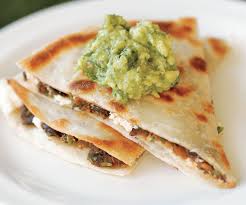
Here is one favourite created by Chris Mohv, owner of Mohv Results, Inc. This interesting way of using whey not only adds variety and interest to a meal, but it also offers 22 grams of protein and 10 grams of fiber.

VEGETABLE QUESADILLA WITH PROTEIN GUACAMOLE
protein guac

Ingredients:
Quesadilla
– 3 snack bites of Cabot Light Cheese (50% less fat) or 2.25 oz shredded cheese
– 1 sprouted whole grain tortilla
– ¼ onion, grilled
– 3 slices of fresh tomato

Guacamole
– 1 avocado
– ¼ cup whey protein isolate, unflavored (about 1 scoop)
– 1-2 tbsp chopped fresh cilantro
– Juice of ½ lime
– Pinch of salt

Makes 2 servings

Quesadilla:

  1. Place the cheese on the whole grain tortilla.
  2. Spray a small pan with nonstick cooking spray and warm over medium heat.  Add the tortilla to the pan, cheese side up.
  3. When the cheese is melted, top with grilled onions and fresh tomato.  Fold the tortilla in half and remove from the pan.  Cut in half.
 Guacamole:
  1. Slice the avocado in half and remove the pit.  Scoop out the avocado and place in a medium bowl.  Mash until smooth.
  2. Add whey protein isolate, cilantro, and lime juice.  Combine until smooth.  Flavor to taste with salt.
  3. Scoop half of the guacamole onto each quesadilla slice.  Serve immediately.
Variation:
Substitute grilled onions and tomato with your favorite vegetables.
Ingredient substitutions will change the nutrition information.

Nutrition information for 1 serving (½ of the quesadilla topped with ½ of the guacamole): 368 calories, 22 g protein (including 8 g of whey protein), 26 g carbohydrate, 10 g fiber, 22 g fat, 6 g saturated fat, 291 mg sodium
Also contains: vitamin A, vitamin B6, vitamin C, folate, vitamin K, calcium, copper, potassium

For more information and about whey, visit:

http://wheyprotein.nationaldairycouncil.org/

There are many more recipe ideas on this site too!!

Hyponatremia: Signs, Symptoms and Warnings

Ilana Katz MS, RD, CSSD

Hyponatremia tends to be mostly associated with athletes who participate in long duration sports such as marathons and triathlons. Endurance athletes taking in water during training or an event can develop hyponatremia, a potentially life threatening condition that occurs when sodium levels drop to a dangerous low in the blood stream (below 135 mmol/L (of blood). Early symptoms may include nausea, drowsiness, confusion, headache and fatigue. These can quickly progress to seizures, coma and death if not resolved in time. Importantly, athletes are not the only population that needs to be aware of this deadly phenomenon.

Dilution of sodium can result, as mentioned, from over-drinking, but also from water retention (often a side effect of various medications). Sodium can be lost in various ways other than dilution which include urination, perspiration and gastrointestinal distress (vomiting/diarrhea). Furthermore certain medical conditions such as congestive disease, kidney dysfunction and ineffective ant-diuretic hormones are known causes.

Since hyponatremia has usually been associated with endurance sports, those who engage are much more well-informed than in the past, and emergency staff who treat athletic stress conditions are also far better educated to recognize and manage symptoms, and even play a role in prevention. The sports medicine community has been helpful in raising awareness about risks and signs of over-hydration. However, with obvious evidence that there are many other populations at risk for hyponatremia, it is vital to recognize these so that all health care professionals are on the leading edge of avoidance and if necessary, acute care.

Some examples of patients who may be eligible for high alert:

  • Psychiatric patients with a syndrome known as psychogenic polydipsia, meaning they drink excessive amounts of water..
  • Multi-pharmocological patients (especially elderly). Why, well because many medications have potential risks.
    • Diuretics deplete electrolytes, including sodium
    • Antidepressants increase level of antidiuretic hormone
  • Patients being administered intravenous hypotonic fluids: hypotonic fluids contain a lower concentration of sodium than blood and thus excessive quantities at high entry rate can dilute sodium.
  • Tube fed patients: proper fluid levels and electrolyte balance must be continuously monitored and orders adjusted based on results of consistent blood work.

There is also the all controversial sodium debate to consider. Researchers and health practitioners often have opposing arguments as to whether dietary sodium should always be strictly conserved. While lowering sodium is unarguably beneficial for those already diagnosed with hypertension (high blood pressure), increasingly conservative recommendations for the average population is often contested. The argument being that too little sodium can lead to other health problems, the main one being hyponatremia. Interestingly, the dietetic community are in agreement that avoidance of dietary sodium is unlikely to cause hyponatremia. Even a very low sodium diet of 500 – 1000 mg/day should maintain adequate levels under normal circumstances. It is the complexity of what defines “normal circumstances.”

In summary, with regards to controlling appropriate levels of sodium in the blood and avoidance of hyponatremia, not only athletes should be aware of hyponatremic signs and symptoms. For those with a normal blood pressure, eating patterns and water intake should be developed based on clinical judgement, guidelines and scientific evidence.

glass of ice blue


Body Temperature: a Metabolic Thermostat

Ilana Katz MS, RD, CSSD


It seems the climate in most areas is a topic of conversation these days. It’s not that we are making small talk with weather conditions, but the unusual climates are setting in. Freezing way before winter starts, or a few hot days emerging in the midst of a cold spell, and vice versa for Summer. So how does a cyclist (or endurance athlete) know how to dress, or even eat accordingly, when they could experience four seasons in a matter of hours. In this article I intend to address how temperature changes ones metabolism, and if you as an athlete can use varying nutrition to take the most advantage of what Mother Nature has to offer.

As body temperature increases, so does metabolism. Thus temperature and metabolism become directly related and metabolism itself is directly affected  by all daily living components, that is eating, sleeping, exercise and physical exertion.

Body Temperature and Metabolism

Working muscles cause the internal body temperature to increase. The physiology of blood transporting oxygen as needed  and removing the byproduct requires the metabolism of calories, or as we know it, food energy. This further translates into the more activity, the higher the body temperature, and the ultimate requirement an increase in the metabolism of more calories. So the question becomes what happens in cold weather. A cold body temperature decreases the chance of burning more calories. So one would think that  if you have not dressed warmly enough for a long ride in winter, you may jeopardize your chances of burning calories. Actually, the opposite is true, and here is a good time to introduce the difference between internal and external body temperature. Internal body temperature will rise when a body is active, this is a given. When externally the temperature is extremely cold, physiology takes over to ensure the internal temperature is safe and warm, hence the effect of shivering. Simply put, movement of bones and muscles become involuntary to generate heat. So how does food choices on a long ride effect this, actually very little. The important thing is the cyclist is giving the body enough food to provide the fuel the metabolism is demanding.

Types of Metabolism and Body Temperature

Most of the calories burned on a daily basis actually takes place during resting periods, also known as basal metabolism. Basal metabolism includes all of the body’s natural functions required to sustain life. The basal metabolism varies from individual to individual, typically affected by health conditions, body composition and body temperatures.

Through your cycling efforts, more calories become metabolized due to the increase in the body’s temperature through working muscle tissue. Calories required for this and other physical activity account for some of the calories needed for basal metabolism, but not as many as most people think. In other words, if you catch yourself allowing a feast fit for a king because you rode a couple of hours, you may be missing the point, especially if you are trying to get leaner. For an optimal burn in fat, not every calorie needs to be replenished post work out, and furthermore, the body has a lot more potential to store calories (stored calories = fat) as it becomes more of an efficient machine. Aerobic endurance (which cycling certainly is) has the potential to teach your body to become efficient, which also means, you would require less fuel to get through the same ride today, as you did a year ago.

The amount of calories metabolized through exercise and muscle exertion does however increases the body’s basal metabolism over time, and certainly temporarily after a long ride. But remember basal metabolism, is different to the fuel needed for during a long ride.

There are many calorie calculators (apps and online) that can give you an average caloric burn per hour. But be warned, these calculators are all basing the calculations on the middle of a bell shaped curve (average) of what you enter in to them.  For example the amount of caloric burn for an average size male (170 lbs)  riding at about 16 – 18 mph is about 800 calories. My point is, there is no way the calculator can know where this individuals basal metabolic rate lies, what his muscle mass versus fat mass is, if he has a history of long consistent endurance training or is a newbie – all these factors, and more, affect this calculation.

There is a silver lining even as we become metabolically efficient, and that is that merely just eating and digesting food,  the body metabolizes some extra. This natural process, often referred to as the thermic effect, increases through the process of eating healthy foods and remaining active. Dehydration and excessively decreasing body temperature reduces the body’s ability to digest food properly.

Muscle Demands

Both muscle strengthening (resistance exercises) and aerobic or cardiovascular activities such as cycling, increase body temperature and break down muscle tissue. In order for muscles to grow and repair broken down fibers, the muscle tissue requires calorie metabolism in order to carry out the functions. This is a continual process which has further demands on the metabolism to work hard consistently, even at rest. In other words, during sleep, muscle groups continue to repair. This is a great physiological explanation of why breaking down and repairing muscle with the correct recovery nutrition increases ones metabolism. In other words, that same 170 lb male in the example above, may actually burn 1000 calories versus 800 per hour cycling, if he has more lean muscle and less fat.

In Summary

The human body regulates internal temperature in order to maintain a steady rate in which normal functions occur. As mentioned above, during the winter or in a very cold room, a human will normally shiver. This natural process represents the body fighting in order to keep muscles warm and the body temperature stable. The direct opposite of this situation, when external temperatures become extremely hot or even warm, the body sweats in order to keep the body cool. This process does not increase metabolism and neither does shivering, simply because neither of the two raise or lower body temperature, but rather fight to maintain a stable rate. Therefore it is irrelevant as to what the temperature of the food you are eating on the bike, in hot or cold extremes, as long as the food is fuel to compensate the metabolic burn rate.

St. George Marathon – Race Report

marathon2

Ilana Katz MS, RD, CSSD

It’s been more than a week and the obligatory race report has been calling my inner conscience. This marathon report feels especially significant to me, as it was followed by a week of  (sometimes) strenuous hiking and exploring beautiful Utah.

marathon3

Believe it or not, Ironman Chatty, although two years ago for me, still feels like yesterday… I am not ready for another Ironman quite yet, although am having endurance withdrawals. This lead to the declaration of 2016 being the year of  “Just a Marathon.”  Oh yeah, there is even a hashtag for #justamarathon, for all the crazy ultra-endurance peeps who one day “submiss” themselves to just a marathon. For all those others rolling their eyes, don’t be haters, there is no real help for endurance junkies other than endurance.  I have gone on a tangent now, but: This always reminds me of the time I was giving a sports nutrition seminar to a group called “couch to 5k” and during the presentation I kept saying “its only a 5k”  – granted, I was genuinely referring to the science of sports nutrition that in a 5k one typically does not have to focus on in-depth sports nutrition so to speak, but from their point of view, I was belittling them. Oh goodness did I get schooled when one of the group raised their hand and blurted out “please stop saying it’s just a 5k.”   And I have learned a very important lesson since then… y’all know what that is. On that very note, I will certainly contest that from experience, running a marathon (and training for it) can be just as tough, if not tougher than training and racing an Ironman.  Any takers? (oh you ironman peeps, calm your hormones ;-))

The year of the Marathon began with my application via the lottery for NYC marathon. I was dropped like a hot cake. The usual “we regret to inform you that most first time applications in this lottery are turned down… so keep on trying.” Maybe in year 7 it will happen for me, maybe I will eventually get in to NYC (by which time I would more than likely be hobbling a marathon.)  So that turn down lead me to sign up for a different, lesser known, but probably almost as coveted St. George, and it too was a lottery… one that I actually won. Congratulations Runner, you are in it to win it!! And so the training began.

Many months and many long run days later: It was a gorgeous day in St. George. Started off cold, colder than expected.  I was under the false impression that early October is still warm in most parts of the country. I was waiting on the bus to transport all us eager beavers 26.2 miles up the road to the start, comparing my little running skirt and sports bra outfit to many of the over-dressed, sporting hat and gloves, long running tights, bundled in fleece. My inner laugh was “oh are y’all gonna be hot as hell.”   Fast forward 26.2 miles out and 2500 feet elevated from the last sentence. Now look whose laughing. Shivering to the bone, I was very grateful for the space blanket handed to us inexperienced Utah-in-the-Fall newbies. Get this, there were even pit fires one could huddle around, it was very well thought out and warming.

The course was wonderfully scenic, all you ever wanted in a marathon. There were a couple of tough challenges, namely mile 8 – 12ish was just one long climb with no breaks (the elevation map lied).  The reprieve was mile 16 to the end was one long downhill. Now that may sound like chocolate icing on top of a chocolate cake to a marathoner, but some of it was pretty steep, and steep downhills are the other side of the pendulum to steep uphills. Pendulum extremes, no matter which end, are extremely challenging. One really has to put the brakes on if you want to save your quads for as minimal as “walking” the next day (and don’t forget, I had a solid 5 days of strenuous hiking to follow).  I heard that little voice in my head, planted by a fellow endurance junkie, an experienced St. George marathoner, recommending some hill repeat training (and only now did the hill repeat DOWHILL ring a bell…. Oopsy daisy).

I had a difficult time around mile 11 or so, not feeling good, wandering why the hell I sign up for this stuff… I did all the required training, what the fiddlesticks? One starts going over and over in their head what could be different… yeah, could have run more during the weeks, yeah could have trained more on hills, yeah yeah coulda shoulda… but not to diss my training, because from after that bout of feeling miz I started feeling great, and the training pay off started paying off. I could have flown to the end but I had committed interval sets as a race strategy. Famous last words from coaches; Stick to the race plan. It also included some mmm…mmmm delish mocha gels every 30 – 45 minutes, and boy when you are really focused on getting sports nutrition right, you better find a flavour that you can stomach. Mocha y’all. Specially for those coffee addicts. Its my new favourite.  Sickly sweet salted caramel move over.

I was sorry I did not have my phone or a camera to capture the experience, because it was a great one. I do not have any good shots from the race photographer, because I was wearing too many race belts (fuel, interval timer, and race number all on different straps)  and all these straps tied around my waist – hence race number landed facing the back, and that’s where it stayed… co-ordinating race belts and still feeling comfortable is an oxymoron.  I have proof of all this in the marathonFoto proof:

(at least MarathonFoto captured one running pic, and one finisher pic).

marathon1

I have done a few marathons to date, and this one is definitely one of the more beautiful ones. It is very well organized from the expo, to the transport, to the start area, line up and finisher experience. It was an awesome plan B to a turned down NYC entry. I recommend it. And then being on one of the most beautiful states it is worth an extended trip to get in some scenic encounters.  I stayed on, accompanied by a couple of hiking buddies, we explored some of the well known National parks around Utah. From Zion, to Bryce, on to Canyonlands and Arches. Every one of these hiking days was unique, and completely different to the day before. Every wince (don’t forget I am hiking on marathon legs) was worth it.

The year of the Marathon take aways:

–          Never belittle your goals. There is no such thing as “just a marathon” similarly there is no such thing as “Just a 5k”

–          Mocha is the new salted caramel flavour

–          Utah is gorgeous.

–          St. George is a great plan B, if not even a Plan A, for a marathon bucket list item.

–          Utah is cold in the early stages of Fall.

–          I pronate on a downhill run (and paid for it via ankle swelling and bruising all through my hiking week)

–          Downhill is just as hard as uphill, I swear!

–          Elevation maps with tiny scales can be deceiving

–          I am still good at sports nutrition 😉   – great marathon, finished strong, even though it got hot in the end.

–          Hello, my name is ilana… I am an endurance junkie

ilana-in-bryce